
EXHIBITION ARCHIVE
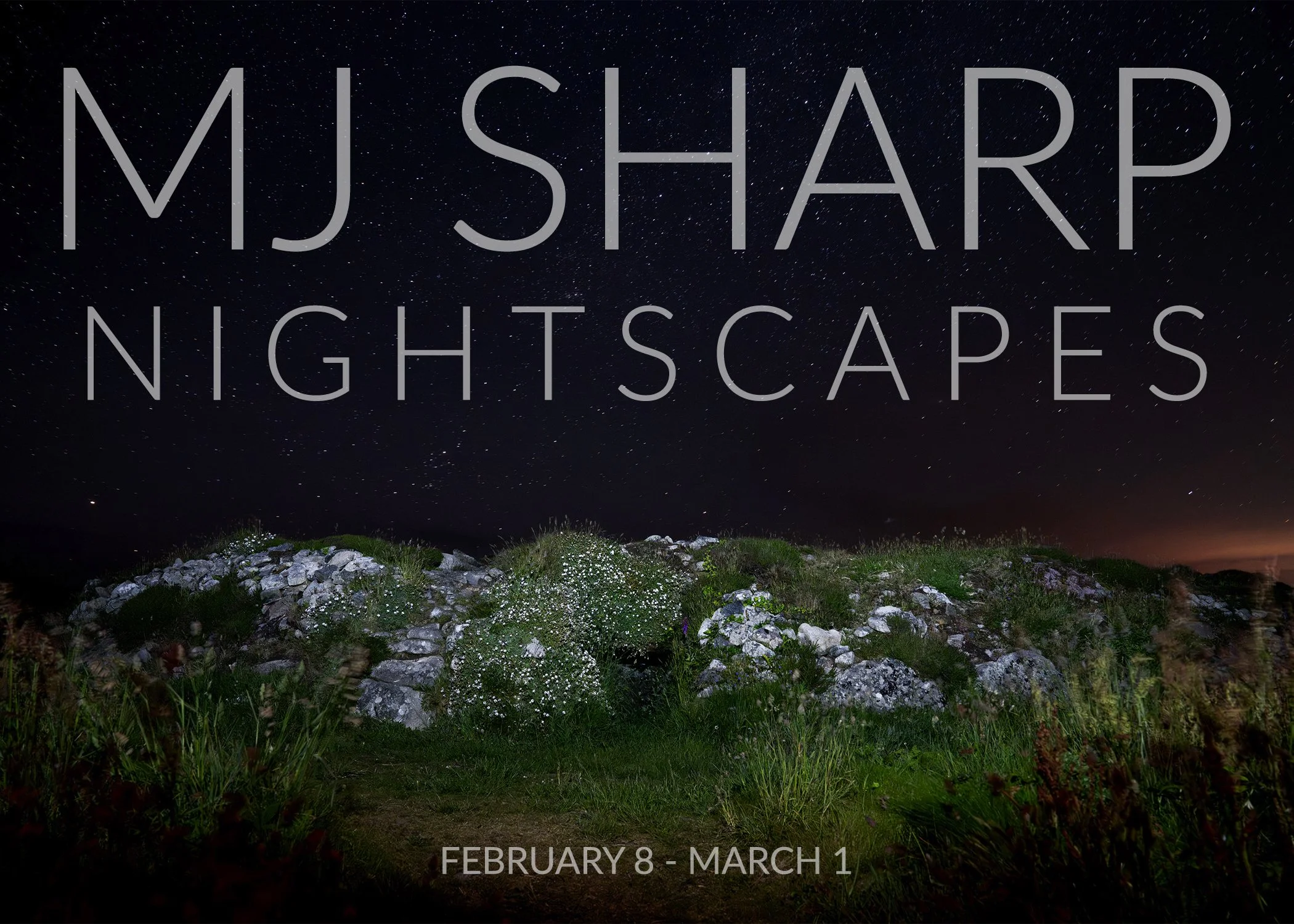
Nightscapes
February 8 - March 1, 2025
Nightscapes features a selection of landscape and still life photographs exploring MJ Sharp’s fascination with preserving the human relationship to night and darkness.
As a Fulbright Scholar to the UK, MJ Sharp collaborated with a nocturnal ecologist who is also concerned about escalating light pollution and our loss of night and darkness. Archaeologists in Cornwall have newly discovered evidence that prehistoric peoples visited ancient megalithic sites in low light or at night. Sharp was intrigued and set out to photograph these ancient sites at night, hoping that it “might be restorative for present-day people who have lost access to their evolutionary birthright of experiencing darkness and night.”
Craven Allen is pleased to show and offer the first printed work from this important body of images, which up to now have only been seen as projections, most recently in her solo show at the College of Wooster Art Museum in Ohio. Also on display for the first time will be still lifes from the past from the past five years and select night landscapes that have not been previously shown.
In the two decades that MJ Sharp has been exploring “the dark and the liminal” in her photography, the increasing effects of light pollution have only strengthened her connection to this unique photographic approach. “A vanishingly small percentage of our evolutionary time as human beings has been spent in artificial light” she explains, “now, for a large percentage of the world’s population, the experience of night is quickly becoming a boutique and exceptional one.”
This is MJ Sharp’s second solo exhibition at Craven Allen Gallery.
STATEMENT
I started photographing exclusively at night just over 20 years ago, and the drive to spend time in quiet, dark places and wait for them to reveal themselves feels even more relevant today. The “attention economy” is a concept that goes back over 50 years. Psychologist and economist Herbert Simon went on to posit that "a wealth of information creates a poverty of attention,” a societal ill that has exploded in the years since.
While a moonlit prehistoric quoit in Cornwall and a dimly illuminated botanical study in Durham would seem to have little in common, the focused attention they inspire is, in fact, quite similar. Long looking and the resultant long exposures produce a kind of intermediate reality that is not available in real time. I experience most of my subjects as dark and undifferentiated monochromes, but when I’m lucky, the alchemy of photography turns them into luscious and detailed scenes that invite immersion and contemplation.
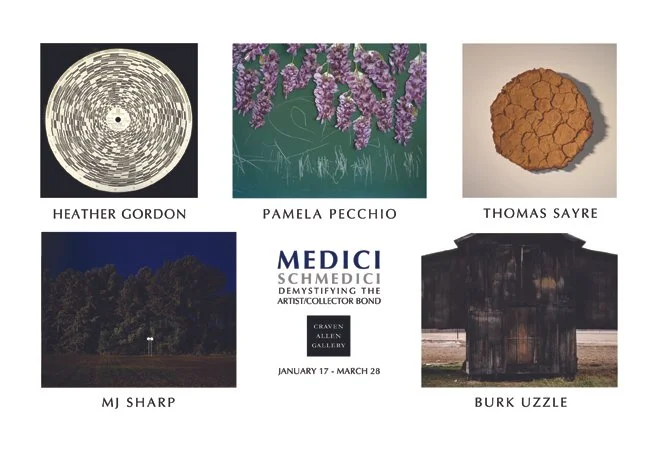
Medici Schmedici: Demystifying the Artist/Collector Bond
January 17 - March 28, 2015
This exciting show explores the work of nationally known artists in conjunction with local collectors to encourage a new generation of arts supporters.
The artist/collector pairs are: Mixed Media Work by Heather Gordon/Collector Amanda Hughes; Photographs by Pamela Pecchio/Collectors Kate Bottemley and Jefferson Holt ; Sculpture by Thomas Sayre/Collectors Alan and Marty Finkel; Photographs by M J Sharp/Collectors Ellen Cassilly and Frank Konhaus; and Photographs by Burk Uzzle/Collectors Emily Kass and Chuck Weinraub.
STATEMENT
Backboard is a textbook case of a collector’s salutary influence on an artist’s process. A few years ago Frank Konhaus and I were down at my studio curating an upcoming solo show of my work. True to form, Frank was being warm, funny, perceptive, and supportive as he helped unearth and evaluate years of prints in all stages of iteration there at my studio. We were looking at a few different versions of Backboard, none of them the one you see here. I was regaling him with how that scene had completely eluded me. I’d photographed it on numerous nights with numerous cameras and lenses from numerous angles, and, as I’m wont to say, I couldn’t buy a composition out of it. I squandered some of our work time together recounting all the ways that photograph was the one that got away, and then we went back to digging around in our respective piles.
Some time later, Frank called over to me, “Did you look at this one?” Sure enough, there it was, my ideal rendition of the scene. Turns out it was one I had created on an 8x10 camera and then filed away because it’s wasn’t a format I was working with much at the time.
A similar thing happened with the work Outside Amarillo, now in the collections of the North Carolina Museum of Art and the Nasher Museum of Art at Duke University. In that case, not only did Frank begin supporting that image from its most rudimentary beginnings (I had photographed it back in graduate school and showed the first working print of it at an Open Studio there), but he continued to champion it to me when my attention kept wandering off to whatever I’d photographed lately. He went on to insist that Outside Amarillo wanted to be a very large print (he was right) and backed up his opinion by commissioning the first one of six of the 40x50 edition size.
I think sometimes people imagine that “collectors” are people who write a check to an artist or gallery. True, collectors do that and in a non-casual way, but to an artist, a collector is far beyond a financially supportive art appreciator. A collector is someone who “gets” you and what you’re trying to do in the world. A collector is someone who enjoys the occasional golden egg but is equally concerned about the health of the goose. A collector is someone who expends precious cultural capital touting the importance of your artwork to others. And in Frank and my case, a collector is the one you’re on the phone with more than your spouse when in the homestretch of mounting a show.
Speaking of spouses, Ellen Cassilly, Frank’s lovely and talented spouse, has been there at every critical junction, whether it was a curatorial conversation or a late-night artwork installation. Notably, Ellen is remarkably cheerful when, as often happens, she is quite suddenly pressed into service.
Frank and Ellen are untiringly generating or contributing to so much of the wonderful cultural revival that is going on in our area. They are treasures, and our community, our region, our culture, our age is so much the better for them. The effects of their industry and their generosity will outlast us all.
Light Cache
December 3, 2011 - January 28, 2012
Light Cache, Sharp’s exhibition of photographs on view at Craven Allen Gallery in Durham, NC through January 28, 2012, is a collection of large format, long exposure renderings that depict domestic objects and scenes along with regional and international landscapes. Many of these scenes and landscapes have been taken at night. This is the part of Sharp’s practice that I have been fascinated with since we met as entering MFA’s at the University of North Carolina at Chapel Hill in 2005. In the announcement for her exhibition, she explains her nocturnal impulse: Though originally motivated to shoot at night because I wanted to be out in the world when it was at its most quiet, dark, and restful, I later found myself staying out all night because I loved the visual results. At night the elements of a scene have a completely different relationship with each other than they have in the daylight—a relationship much less about color and much more about reflectance. The flurry of daytime details falls away at night, leaving only the bare bones of a composition, and light-reflective objects seem to emit their own light.
Light, color and composition are key elements of both photography and painting. Sharp obviously understands this-hence the reason I term her photographs as renderings-and pushes the boundaries between the two disciplines. With her collection of well-worn cameras, she renders layers of light in a painterly fashion thereby creating images that demand a more slow-fire interaction. That said, it is no surprise that when asked about her inspirations, she quickly rebounded with Theresa Handy- a Midwest landscape painter that Sharp originally discovered while in New Mexico well over a decade ago. Sharp is also a collector of the painter’s work. Although Handy has since changed her style, Sharp remains focused on a period of the painter’s practice that combines minimal landscape compositions with glazing. Here, veils of color are painstakingly layered to produce depth and luminescence akin to Master Dutch and Italian painters of centuries past that inform Sharp’s approach to rendering photographic images.